
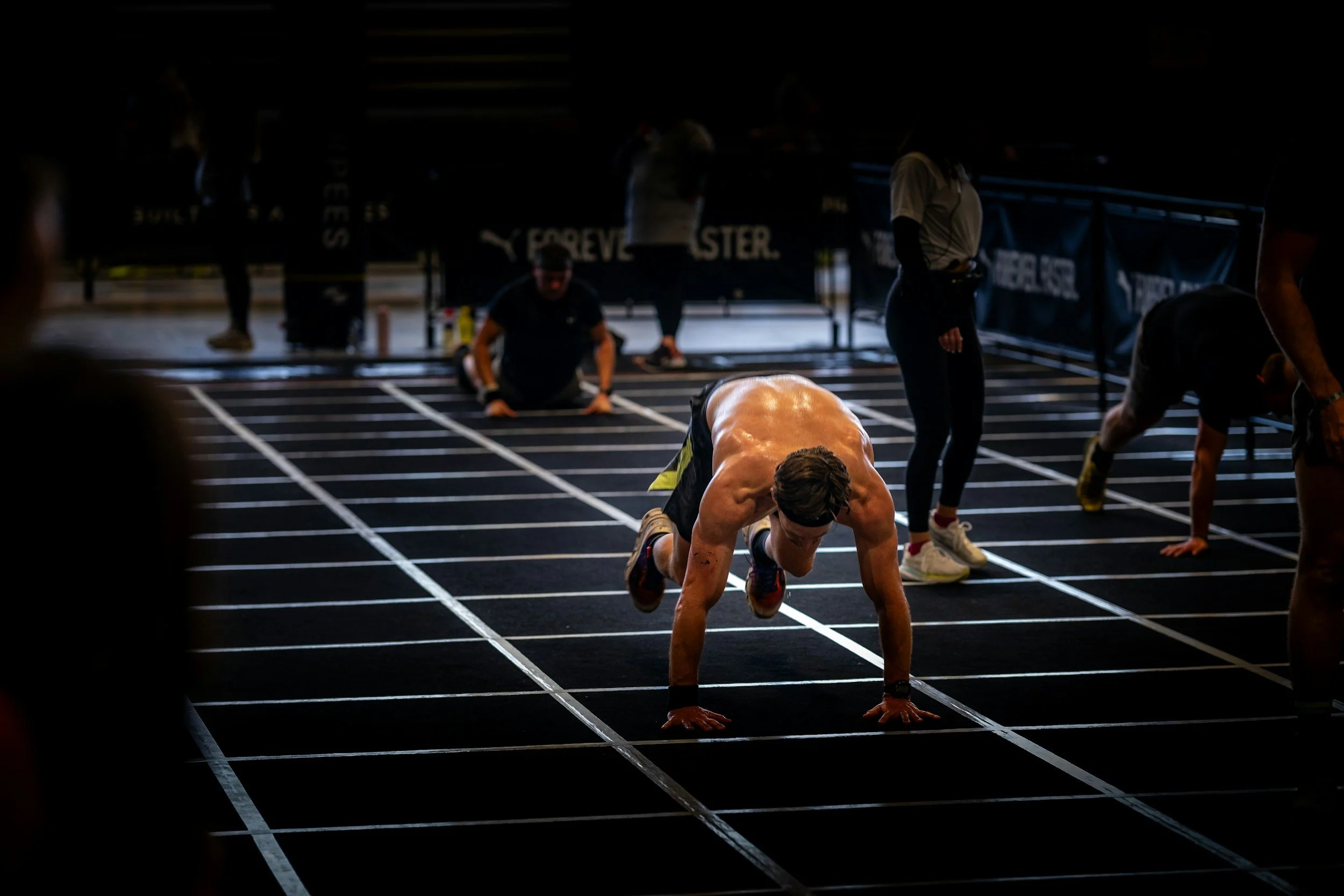
DEKA in more detail…
The DEKA Race is a structured, performance-driven fitness challenge that combines running with functional training across 10 progressive zones. Designed to test strength, endurance, and consistency, it delivers a balanced and competitive hybrid race experience.
Athletes complete 10 x 500m runs (totalling 5 km), with each run followed by a dedicated workout zone. These zones feature a mix of functional movements including rowing, ski erg, sled push/pull, farmer’s carries, box step/jumps, wall ball variations, and burpee-based exercises.
Each zone targets a different aspect of fitness, combining:
Distance-based efforts (e.g. runs, ergs, carries)
Repetition-based movements (e.g. step-ups, burpees, dead ball work)
Calorie-based output (air bike efforts)
Weights and standards are scaled for male and female competitors to ensure fairness while maintaining intensity. In doubles format, athletes share the workload, adding a strategic and team-focused element to the race.
The DEKA format is built to challenge aerobic endurance, functional strength, and pacing strategy, making it suitable for both first-time competitors and experienced hybrid athletes.
General Rules:
It is the responsibility of each racer to complete all run segments and workout stations as prescribed, in the correct sequence, and to clearly demonstrate that all required movement standards are being met throughout the race.
Judges: Enforce strict standards for repetitions and form.
Pairs: In pairs, the 600m runs are done together, but reps/distances can be split between partners. Mixed Pairs require both partners to perform the workout stations with the various rules of weights so be sure to check the rules.
DEKA has very strict movement standard which can be seen in details in the movement standards video. Link above.
Other DEKA race formats
DEKA STRONG
Complete 10 fitness zones in order with no running.
DEKA MILE
Same 10 zones, but each zone is preceded by a 160 m run (total ~1 mile).
DEKA FIT Ultra
A long course where the 10-zone layout is repeated five times (total 25 km).
DEKA ATLAS
A separate strength-focused test with 10 zones in a 30-minute time cap.
Hybrid NW in more detail…
The Hybrid NW Race is a high-performance fitness challenge that blends endurance running with functional strength across a series of demanding workout stations. Designed to mirror elite hybrid competition formats, it tests stamina, power, and pacing across a continuous race environment.
Athletes complete 9 x 600m runs, accumulating a total of 5.4 km of running, with each run leading into a dedicated workout station. The race concludes with a final 200m sprint finish, rewarding those who can push to the end under fatigue.
The 9 workout stations include a mix of:
Calorie-based efforts (assault bike)
High-rep functional movements (wall balls, dumbbell snatches)
Distance-based challenges (row, ski erg, burpee broad jumps, farmer’s carries, sled push, sandbag lunges)
This combination delivers a well-rounded test of strength, engine, and movement efficiency, requiring athletes to manage fatigue while maintaining consistent performance across all stations.
Weights and standards are scaled for male and female competitors, with doubles options allowing athletes to share workload and strategy throughout the race.
The Hybrid NW format is ideal for those looking to experience a competitive, Hyrox-style race, combining structured running with functional fitness in a fast-paced, race-day environment.
General Rules:
It is the responsibility of each racer to complete all run segments and workout stations as prescribed, in the correct sequence, and to clearly demonstrate that all required movement standards are being met throughout the race.
Judges: Enforce strict standards for repetitions and form.
Pairs: In pairs, the 600m runs are done together, but reps/distances can be split between partners. Mixed Pairs require both partners to perform the workout stations with the various rules of weights so be sure to check the rules.
Hybrid NW has very strict movement standard which can be seen in details in section 5 “MOVEMENT STANDARDS, DISTANCES AND WEIGHTS” of the HYBRID NW rulebook. Link above.
Hyrox in more detail…
The HYROX Race is a globally recognised fitness format that combines endurance running with functional workout stations in a consistent, race-style structure. Designed for both competitive athletes and fitness enthusiasts, it delivers a balanced test of strength, stamina, and mental resilience.
Athletes complete 8 x 1,000m runs, totalling 8 km of running, with each run followed by a dedicated workout station. The race flows continuously, requiring athletes to manage effort and pacing across both running and functional tasks.
The 8 workout stations include:
Erg-based efforts (ski erg and rowing)
Strength-focused challenges (sled push and sled pull)
Functional movements (burpee broad jumps, farmer’s carries, sandbag lunges)
High-repetition finish (wall balls)
Most stations are distance-based, with the final wall ball station testing muscular endurance through high reps under fatigue.
Weights and standards are scaled for male and female competitors, while doubles format allows athletes to share the workload, introducing teamwork and race strategy.
The HYROX format is known for its standardised global structure, making it ideal for benchmarking performance, tracking progress, and competing at all levels—from first-time participants to elite athletes.
General Rules:
It is the responsibility of each racer to complete all run segments and workout stations as prescribed, in the correct sequence, and to clearly demonstrate that all required movement standards are being met throughout the race.
Judges: Enforce strict standards for repetitions and form.
Pairs: In pairs, the 1k runs are done together, but reps/distances can be split between partners. Mixed Pairs require both partners to perform the workout stations with the male weights.
Hyrox has very strict movement standard which can be seen in details in section 9 “MOVEMENT STANDARDS, DISTANCES AND WEIGHTS” of the Hyrox rulebook. Link above.



Deadly Dozen in more detail…
The Deadly Dozen Race is a fast-paced hybrid fitness challenge that combines continuous running with a wide variety of functional strength and conditioning movements. Built around 12 workout stations, this format delivers a demanding and well-rounded test of endurance, strength, and grit.
Athletes complete 12 x 400m runs, accumulating a total of 4.8 km of running, with each run leading directly into a workout station. The stations feature a diverse mix of movements including kettlebell work, dumbbell exercises, carries, lunges, burpees, bear crawls, and plate-based strength movements.
The race includes a balanced combination of:
Distance-based efforts (carries, lunges, crawls)
High-repetition strength work (deadlifts, squats, presses, snatches)
With 6 distance-based stations and 6 rep-based stations, the format challenges athletes to maintain output across both strength and endurance demands.
Weights are scaled for male and female competitors, while doubles format allows athletes to share both load and workload, adding a team strategy component.
The Deadly Dozen is designed to test consistency, resilience, and full-body strength under fatigue, making it a tough but accessible race for all fitness levels.
General Rules:
It is the responsibility of each racer to complete all run segments and labours as prescribed, in the correct sequence, and to clearly demonstrate that all required movement standards are being met throughout the race.
Judges: Enforce strict standards for repetitions and form.
Pairs: In pairs, the 400m runs are done together, but reps/distances can be split between partners. Mixed Pairs require both partners to perform the labours with the male weights.
Deadly has very strict movement standard which can be seen in the labour standards video. Link above.

Other Deadly track Variations
Deadly Ruck – same format but wearing a weighted rucksack (10 kg male / 6 kg female).
Deadly Mile – shorter brutal challenge with sequential 400 m lunges, burpee broad jumps, bear crawls, and run (not the full 12-station format).
Deadly Youth – scaled version of the Track Race for 12–15 year-olds with reduced volumes/weights.
Deadly Gross – a 12-hour ultra where competitors attempt to complete 12 full Deadly Dozen races within the time cap.
Gym Race Formats (Deadly Gym Races)
The Deadly Dozen concept is adapted into indoor gym-style hybrid races with various cardio machines and strength focuses.
Deadly Barbell - Strength-focused gym meet.
Athletes attempt 2-rep maxes on six classic lifts within 60 minutes:
Snatch
Clean & Jerk
Deadlift
Strict Press
Squat
Bench Press
Deadly Strong
Gym race of the 12 Labours only (no runs or ERG work).
Done as Solo or Pair.
Deadly Erg
Begins with a 1 mile row, then Labours 1–6, 1 mile SkiErg, Labours 7–12, and finishes with 1 mile bike.
Deadly Erg 2
Rotating cardio race between Labours:
400 m row → Labour 1
400 m ski → Labour 2
800 m bike → Labour 3
(Repeat cycle through all 12 Labours)
Solo, Pair, or Relay eligible.
Deadly Row Erg
400 m row ERG between each of the 12 Labours.
Deadly Ski Erg
400 m SkiErg between each Labour.
Deadly Ski Erg
800 m bike ERG between each Labour.
Deadly Air Bike
Perform 24 kcal on an air bike between each Labour.
Deadly Fitness Test (DFT)
A half-race format using 6 “Rep Labours” (Deadlift, Snatch, Squat, Push Press, Clean & Press, Devil Press) with a mix of all four cardio modalities (Run, Row, Ski, Bike or Air Bike) between them.